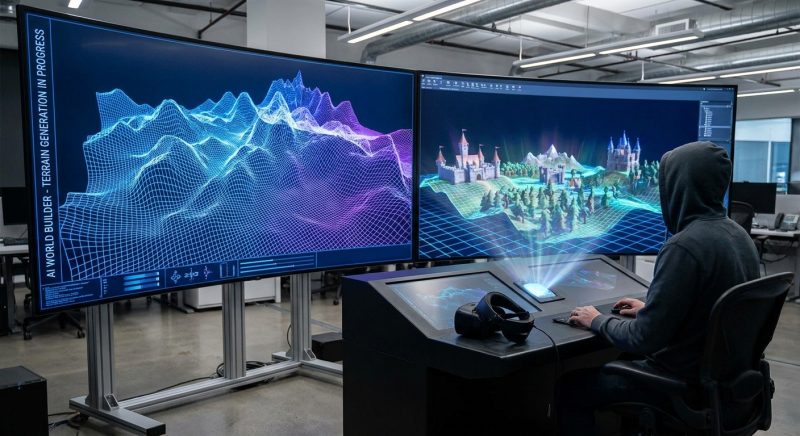
From Vision to Reconstruction: The Era Where AI Sculpts the Digital World
A technical and forward-looking analysis of the technological shift: when AI stops observing reality to reconstruct it in three dimensions.
The Dawn of a New Geometry
For nearly forty years, the craft of 3D artistry relied on artisanal patience. Modeling a digital environment required sculpting every polygon, adjusting every texture, and manually defining the physical properties of every object. It was a discipline of the hand, a form of digital sculpture where time was the most expensive resource. Today, this paradigm is collapsing. We are no longer just teaching machines to "see"—to identify pixels or recognize shapes—we are beginning to teach them how to reconstruct the world.
This shift marks a fundamental transition in the history of computer graphics. The move from passive computer vision to generative reconstruction transforms the developer, once a builder of worlds, into an architect of systems capable of interpreting and replicating reality.
From 2D to Depth: The End of Optical Illusions
One of the most significant breakthroughs lies in our ability to extract depth from two-dimensional sources. Tools like Depth Anything perfectly illustrate this mutation. Previously, estimating the distance of an object in an image was a complex, often error-prone task requiring LiDAR sensors or heavy photogrammetric calculations. Now, AI infers the three-dimensional geometry of a scene from a simple photograph.
This ability to "restore depth" is not limited to a visual effect; it opens the door to immediate integration into game engines. Where it once took days to model a street, a series of snapshots is now enough to generate a usable 3D mesh. The boundary between capturing reality and its digital recreation is blurring, making 3D content creation accessible not just to experts, but to anyone with a camera.
WorldGen: When Text Becomes Geography
If reconstruction from images is a feat, pure generation is a revolution. Projects like WorldGen illustrate this new frontier: AI no longer needs a source model; it can synthesize complex environments from text instructions.
For the developer, this means the "void" of the game engine is no longer a space to be laboriously filled, but a blank canvas that AI can populate in seconds. This automation allows for unprecedented scaling: the creation of vast, coherent, and persistent virtual worlds, once reserved for studios with hundreds of employees, is now achievable by small teams. It is a technological democratization that is redefining the economics of video games and digital twins.
Integration at the Heart of Engines: The Unreal Engine Example
Game engines, such as Unreal Engine, are no longer just rendering tools. They are becoming hosting platforms for these generative AIs. The evolution toward versions like Unreal Engine 5.x shows a clear desire to integrate technologies like Nanite or Lumen, which, coupled with AI-based workflows, allow for near-photographic visual fidelity in real-time.
The future of digital creation lies in this synergy: AI generates the structure, the engine manages the physics, and the developer orchestrates it all. This architecture allows designers to focus on experience, storytelling, and interactivity, rather than the technical constraints of modeling.
The Technological Unconscious and Reconstructed Reality
As Michel de Broin suggests in his reflections on entropic mechanisms, our devices are not mere tools, but extensions of our perception. By teaching machines to reconstruct the world, we are outsourcing part of our own capacity to structure space.
This transition raises fascinating questions for developers:
- Data Integrity: How can we guarantee the physical accuracy of an AI-generated digital twin?
- Augmented Creativity: If AI can reconstruct any scene, what is the added value of human intervention?
- Production Velocity: How do we manage the explosion of automatically generated content without sacrificing artistic quality?
Conclusion: Toward a New Era of Builders
We are witnessing the end of the era of artisanal modeling. The developer of tomorrow will not be the one who manipulates vertices on a screen, but the one who defines the rules, parameters, and intentions of worlds that build themselves. By teaching machines to reconstruct the world, we are not losing our technical mastery; we are expanding the realm of the possible. Technology, by becoming a mirror capable of recreating its environment, finally offers us the tools to build realities that match our imagination.