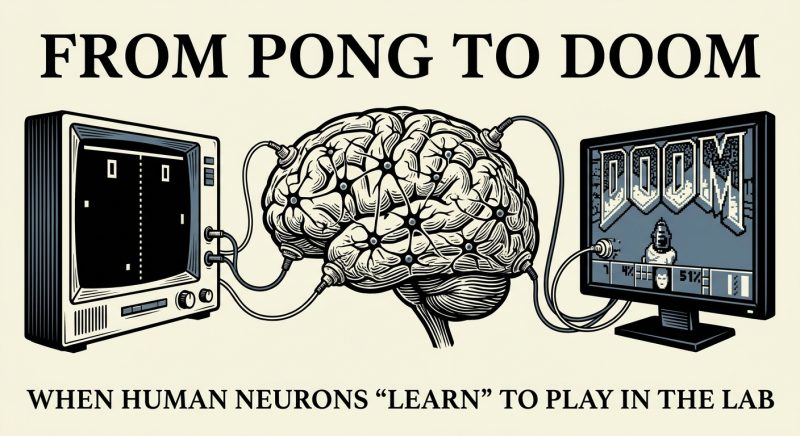
From Pong to Doom: When human neurons 'learn' to play in the lab
Researchers have achieved a technological feat: teaching a cluster of human neurons to play the video game Doom. A spectacular breakthrough that paves the way for a new era of biological computing.
A technological feat worthy of science fiction
"Can it run Doom?" is a recurring joke in the tech community, where the cult video game has been installed on calculators, printers, and even pregnancy tests. However, a recent scientific breakthrough has given this challenge a new dimension: in 2026, it is no longer a machine running Doom, but a cluster of human brain cells grown in a laboratory.
Behind this feat lies a burgeoning discipline: biological computing, or wetware computing. Here, artificial intelligence does not rely on lines of code running on silicon processors, but on a fusion between living biology and electronic hardware.
How does a cluster of neurons play Doom?
Far from the image of a brain in front of a screen, the process is a feat of electrophysiological engineering. Researchers use human stem cells, differentiated into neurons, which they place on a high-density micro-electrode array. These electrodes act as an interface between the digital world and the biological tissue.
The system operates on a closed-loop principle:
- Stimulation: The game Doom does not stream images to the cells. Instead, the game's visual information is translated into precise electrical signals and sent to the neurons.
- Learning: The neurons react to these stimuli with spontaneous electrical activity. The system interprets this activity and converts it into game commands (move, shoot, turn).
- Feedback: If the neurons "succeed" in a beneficial action in the game, they receive coherent and structured electrical stimulation, reinforcing their synaptic connections. Conversely, an erroneous action triggers a chaotic signal, prompting the cells to modify their behavior to optimize their virtual "survival."
A meteoric rise: from Pong to 3D
This success is not a matter of chance, but the culmination of methodical research. In 2022, the startup Cortical Labs made headlines with the "DishBrain" system. At the time, neurons had learned to master Pong, a minimalist 2D game, in just a few minutes.
The transition to Doom in 2026 represents a major qualitative leap. Unlike Pong, Doom imposes a pseudo-3D environment, spatial navigation management, and much more complex reactivity. This evolution demonstrates that "wetware" possesses astonishing adaptive capacity and neural plasticity, capable of adjusting to increasingly sophisticated environments.
Beyond gaming: neuroscientific and medical stakes
While the idea of neurons playing Doom might bring a smile, the goals of Cortical Labs and computational biology researchers are extremely serious. It is not about creating "gaming" artificial intelligences, but about understanding how the brain processes information.
The concrete applications are promising:
- Brain modeling: Studying how neural networks learn and organize helps better understand neurological pathologies like epilepsy or Alzheimer's disease.
- Accelerated pharmacology: These "brains-on-a-chip" serve as a testbed for assessing the impact of new drugs. It becomes possible to observe the reaction of living neurons to molecules in real-time, at a lower cost and without immediate recourse to animal testing.
- Energy efficiency: The human brain is a marvel of energy efficiency. While current AIs consume colossal amounts of electricity to function, biological computing could eventually lead to the design of hybrid computers capable of performing complex tasks with a tiny fraction of that energy.
Although we are still far from creating artificial consciousness, this fusion between silicon and life opens a new chapter in computing. Doom, once again, has served as the ultimate test to push the boundaries of what we thought was possible.