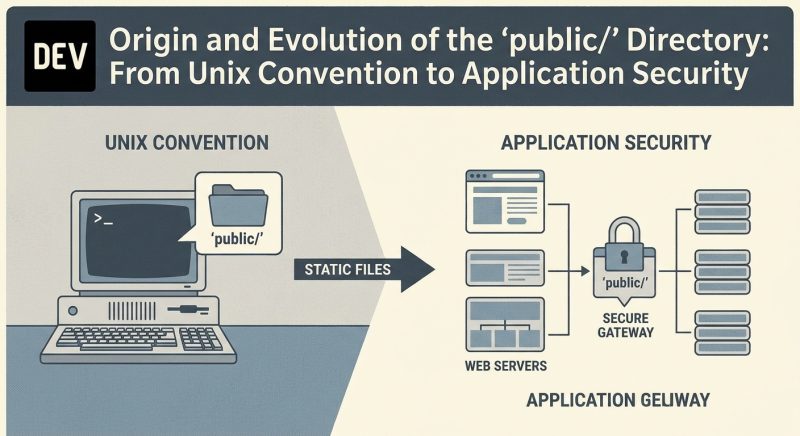
DEV: Origin and Evolution of the 'public/' Directory: From Unix Convention to Application Security
Discover how the 'public/' directory became the essential security standard for isolating web resources, from the invention of NCSA HTTPd in 1993 to the rise of modern frameworks.
The Emergence of a Convention: NCSA and the public_html Directory
In the early 1990s, the web was still an academic and experimental space. In 1993, at the National Center for Supercomputing Applications, developer Rob McCool created NCSA HTTPd, the web server that would become the direct ancestor of the Apache HTTP Server. At that time, servers ran on multi-user Unix systems where each person had a "home" directory containing potentially sensitive data.
To allow researchers and students to publish web pages without compromising the overall system security, McCool introduced the UserDir directive. This convention established the ~/public_html/ folder as the only directory accessible by the HTTP daemon. This architectural innovation was a crucial step for security:
- Privilege isolation: The web server could only read files located in this specific folder, thus protecting the rest of the user's home directory.
- Compartmentalization: System files, private configurations, and personal documents were physically inaccessible from an external HTTP request.
Application Standardization: The Ruby on Rails Era
While the public_html convention laid the foundations for isolation, the evolution of the web toward complex dynamic applications required a new approach. In 2004, the company 37signals (now Basecamp), driven by David Heinemeier Hansson (DHH), revolutionized web development with the launch of the Ruby on Rails framework. This is when the modern public/ directory became an industry standard.
In this new architecture, the public/ directory is defined as the sole entry point for the web server (DocumentRoot). Unlike the previous model, the entire application source code is moved above this web root. This restructuring provides two major benefits:
1. Increased Security Through Code Isolation
By placing business logic, API keys, configuration files (such as .env files), and the app/ directory outside the public root, developers natively neutralize a large class of vulnerabilities. Even in the event of a web server misconfiguration (for example, if it fails to execute a server-side script), the source code remains physically inaccessible to remote clients. The server simply cannot "see" what is outside the public/ folder.
2. The Advent of the Front Controller
The use of the public/ directory allowed for the generalization of the Front Controller pattern. All incoming requests are channeled to a single entry point (such as public/index.php or its equivalent in other frameworks). This centralization offers several advantages:
- Unified routing: Navigation logic is handled by the framework rather than the physical structure of files on the server.
- Centralized filtering: It is easier to apply security policies, middlewares, or logs to a single entry point than to a multitude of scattered scripts.
- Reduced attack surface: By eliminating the direct execution of internal files, risks related to direct access to configuration files or low-level libraries are removed.
Conclusion
From the NCSA's UserDir directive to the rigorous architecture of Ruby on Rails, the public/ directory has evolved from a simple naming convention into a pillar of web security. By strictly isolating static resources from application code, this standard has helped protect modern applications against unauthorized access, while providing developers with a more structured and predictable work environment.