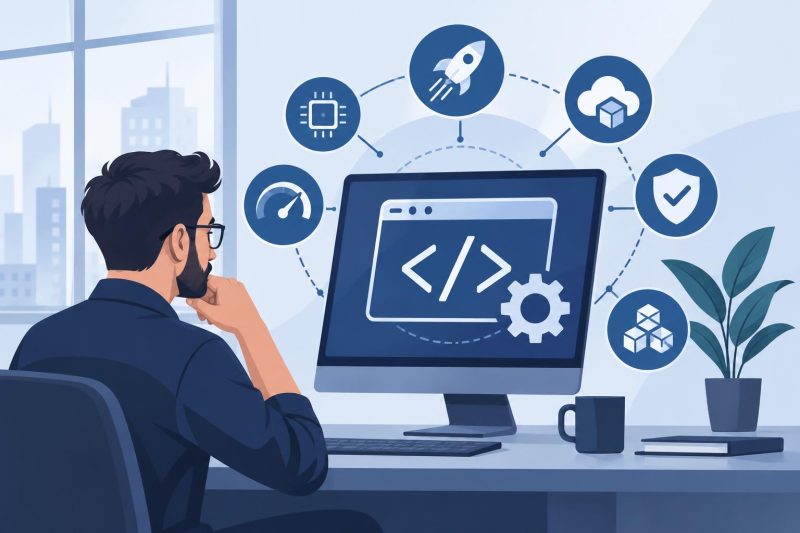
Custom Generative Frameworks Gain Ground Against Traditional CMSs
Driven by generative AI, composable architectures and the need for differentiation, bespoke solutions are transforming web development practices, without making WordPress and established frameworks disappear.
Web development is entering a phase of accelerated customization. While WordPress remains the most widely used CMS in the world, product teams and agencies are increasingly turning to bespoke architectures built from generative building blocks, APIs and components tailored to a brand’s specific needs.
This shift does not mean the end of frameworks such as React, Next.js or Laravel. Rather, it reflects a change in approach: instead of adopting a theme, a technology stack and standardized extensions, developers can now generate a customized application foundation, then enhance it with specific components, headless services and automations driven by artificial intelligence.
From theme customization to product generation
Traditional CMSs have long met an essential need: publishing a website quickly, with an accessible administration interface and an ecosystem rich in extensions. WordPress therefore retains a dominant position in the web landscape, particularly for editorial sites, small and medium-sized business showcase sites and certain e-commerce projects.
But this model shows its limits when user experience, business workflows or performance become strategic. Stacking plugins can weigh down a site, make its maintenance more complex and introduce security or compatibility risks. In this context, customized generative resources make it possible to create interfaces, data models and business workflows directly aligned with the project’s objectives.
Code assistants and interface generation tools are accelerating this approach. They can produce functional mockups, front-end components, tests or API connectors from detailed instructions. The role of developers is therefore evolving: it is no longer only about assembling existing extensions, but about designing, controlling and maintaining an application foundation that is genuinely differentiating.
The advantages of customized architectures
- A more distinctive experience: interfaces are no longer constrained by the limits of a theme or page builder. Design, navigation and features can precisely reflect the brand’s identity.
- Better performance: an application designed for a specific use includes only the necessary dependencies. This efficiency can improve loading times and user experience metrics.
- Easier integration: API-first architectures make it easier to connect CRMs, payment tools, databases, e-commerce platforms or AI services.
- More controlled maintenance: a reduced, documented technical foundation limits reliance on a proliferation of third-party extensions, even if responsibility for maintenance rests more heavily on the development team.
- Better adaptation to business needs: dashboards, extranets, configurators, customer portals and internal processes can be developed around actual uses rather than around the standard functions of a CMS.
The composable model is gradually gaining traction
The trend is part of the rise of so-called “composable” architectures. In this model, the front end, content, payments, search and authentication are independent services connected through APIs. A company can, for example, retain a content management tool while deploying a customized front end generated from React or Vue components.
This approach avoids the simplistic opposition between “all WordPress” and “all bespoke.” For many projects, the CMS becomes one content building block among others, sometimes in headless mode, while the experience visible to the user is developed independently.
A transformation that must be managed
Code generation does not eliminate the need for expertise. A customized project requires sound architectural choices, code reviews, testing, attention to accessibility and a clear security policy. Code produced by an AI must be checked, particularly when it concerns authentication, personal data or payments.
CMSs and general-purpose frameworks therefore remain relevant for simple projects, limited budgets or needs for rapid publishing. However, for companies seeking to turn their website into a digital product, customized frameworks and generative resources offer a more flexible, higher-performing and more differentiating path.