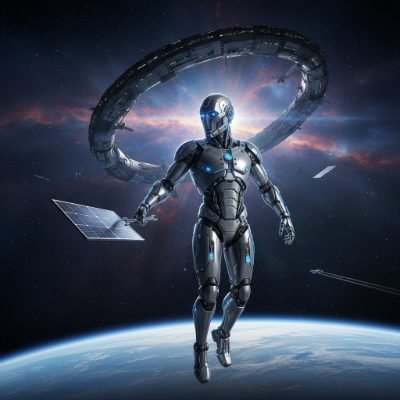
Robots and Humans in Space: Towards Inevitable Synergy
Space exploration is at a crossroads, facing the question of coexistence between autonomous robots and humans, or even a merger of the two. This article explores how machines and astronauts collaborate to push the boundaries of the universe.
The Era of Space Coexistence
Space exploration has always been a field where technology pushes human limits. Today, the question is no longer whether robots belong in space, but rather how they coexist and collaborate, and even how the distinction between "human" and "robot" might blur in the future. Is it an autonomous robot in deep space, an augmented human, or even a humanoid so sophisticated that it becomes a "robot human"?
Robots, Pioneers of the Inaccessible
Robots have become indispensable actors in space exploration. Their advantages are manifold: they do not require life support, are more resistant to radiation and extreme temperatures, and can perform repetitive or dangerous tasks without risk to human life. From NASA's Martian rovers like Perseverance and Curiosity, which analyze geology and search for signs of past life, to maintenance robots aboard the International Space Station (ISS) such as Astrobee, machines are on the front lines. The European Space Agency (ESA) and JAXA (Japan Aerospace Exploration Agency) are also developing advanced robotic technologies for future lunar and Martian missions, including resource extraction and infrastructure construction.
The Augmented Human and the Humanoid
The idea of a "robot human" takes several forms. On one hand, there is the human operator controlling robots remotely, often with dexterity and decision-making capabilities that machines still struggle to match. On the other hand, research is exploring the augmentation of human capabilities via exoskeletons for walking on other celestial bodies or implants that enhance astronaut health and resilience. Finally, humanoids like NASA's Robonaut 2 or JAXA's astronaut robot Kirobo, designed to interact with astronauts, embody the effort to create machines that not only resemble humans, but can also share workspaces and complex, even emotional, interactions.
Synergy: The Future of Exploration
The future of space exploration likely does not lie in an exclusive choice between human and robot, but in their synergy. Robots will act as scouts, builders, and assistants, paving the way for human missions and managing the most arduous or dangerous tasks. Humans, with their unique capacity for adaptation, unforeseen problem-solving, and intuition, will supervise, direct, and make strategic decisions. NASA's Artemis program, aiming to return humans to the Moon, is an excellent example of this collaborative approach, where human presence will be heavily supported by robotic systems for exploration, construction, and logistics.
Conclusion
The boundary between human and robot in space is increasingly porous. Whether it involves autonomous robots pushing the boundaries of exploration or technology-augmented humans surviving and thriving beyond Earth, the goal remains the same: to unlock the mysteries of the universe. Collaboration between human intelligence and robotic efficiency is the key to reaching the stars.