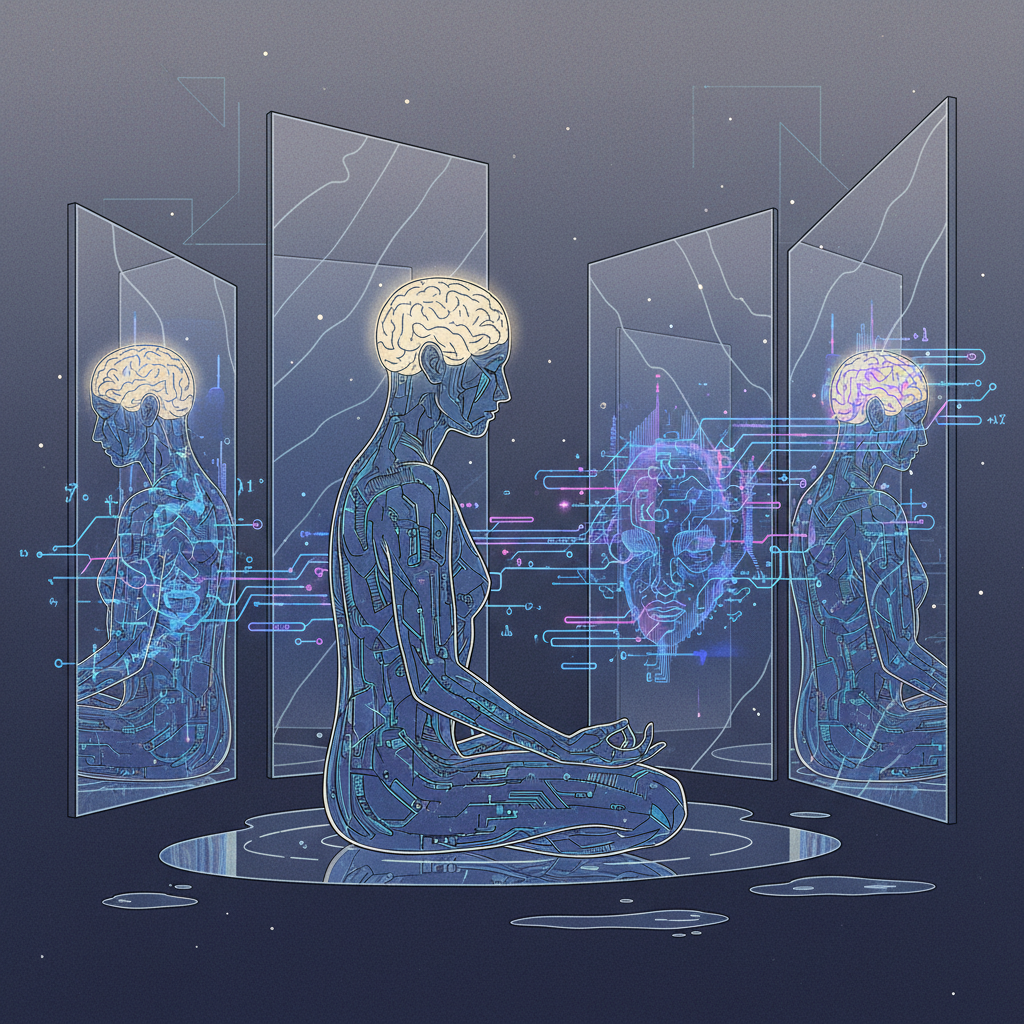
Artificial Introspection: When AIs Learn to Understand Themselves
Dive into the heart of artificial introspection, an emerging field where AI systems develop the ability to analyze their own processes. Discover why this quest for transparency and self-understanding is crucial for the future of artificial intelligence, from ethical reliability to performance enhancement.
Artificial Introspection: A New Frontier for AI
As artificial intelligence (AI) integrates deeper into our daily lives—from medicine and finance to autonomous vehicles—a fundamental question emerges: how do these systems make their decisions? The concept of "introspection in AI reasoning" refers to an AI system's ability to analyze its own internal processes, understand why it acted in a certain way, and evaluate the validity of its own conclusions. Far from being a mere philosophical curiosity, this capability is becoming a vital cornerstone for building more reliable, ethical, and high-performing AI systems.
The "Black Box" Challenge and the Quest for Transparency
Historically, many AI systems, particularly deep neural networks, operate as "black boxes." While they excel at predicting or classifying, their internal mechanisms remain opaque, making it difficult to comprehend the underlying logic behind their decisions. This lack of visibility presents major challenges:
- Lack of Trust: How can we trust a system whose reasoning we cannot comprehend, especially in critical domains?
- Debugging Difficulties: Without internal visibility, identifying and fixing errors or biases becomes a complex process.
- Ethical Responsibility: In the event of a system failure or controversial decision, who is held accountable if the decision-making process is incomprehensible?
Artificial introspection aims specifically to break down this opacity by equipping AIs with tools to self-analyze and potentially explain their reasoning to humans.
Why Introspection Is Essential for the Future of AI
Integrating introspective capabilities offers multiple, crucial benefits:
1. Strengthening Trust and Ethics
Systems capable of explaining their choices will be perceived as more transparent and trustworthy—a vital factor for adoption in sensitive sectors. Introspection also helps identify and mitigate algorithmic biases that might otherwise perpetuate or amplify existing discrimination.
2. Enhancing Robustness and Performance
By understanding why an error occurred, an AI can learn not to repeat it. Introspection helps pinpoint gaps in training data or weaknesses in model architecture, leading to more robust systems that adapt better to new situations.
3. Facilitating Human-Machine Interaction
An AI that can articulate its thought process can collaborate more effectively with human operators by providing contextual information and justifications, transforming the dynamic from a simple user interface into a true partnership.
Current Methods and Research
The field of Explainable AI (XAI) sits at the core of this introspective quest. Researchers are exploring various approaches:
- Post-Hoc Methods: Analyzing a model's behavior after it has made a decision (e.g., LIME, SHAP).
- Intrinsically Explainable Models: Designing AI architectures whose mechanisms are transparent by design (e.g., decision trees, symbolic models).
- Causal Reasoning: Equipping AIs with the ability to understand cause-and-effect relationships rather than relying on mere correlations.
- Neuro-Symbolic AI: Combining the power of neural networks with the clarity of symbolic reasoning to achieve greater interpretability.
Institutions such as Google DeepMind, OpenAI, and leading research universities are actively conducting intensive research to equip AI with these self-analytical and explanatory capabilities.
Future Perspectives and Strategic Stakes
Artificial introspection extends beyond simple explanations. Over time, it could lead to AIs possessing a rudimentary form of operational self-awareness—systems capable of questioning their own knowledge, formulating new hypotheses, and learning more autonomously. However, immense challenges remain, particularly the task of simulating genuine understanding rather than a superficial facade of explanation. Interdisciplinary collaboration among computer scientists, philosophers, and ethicists will be critical to navigating this new era of AI.
"Looking toward 2030, artificial introspection could transform high-performing AI into a genuine decision-making partner. Imagine an AI that not only predicts, but deliberates with you on outcomes, suggests alternative paths, and raises its own questions—all powered by a 'neuro-symbolic' architecture. To make this vision a reality, collaboration between computer scientists, philosophers, and ethicists is no longer optional: it is a necessity."