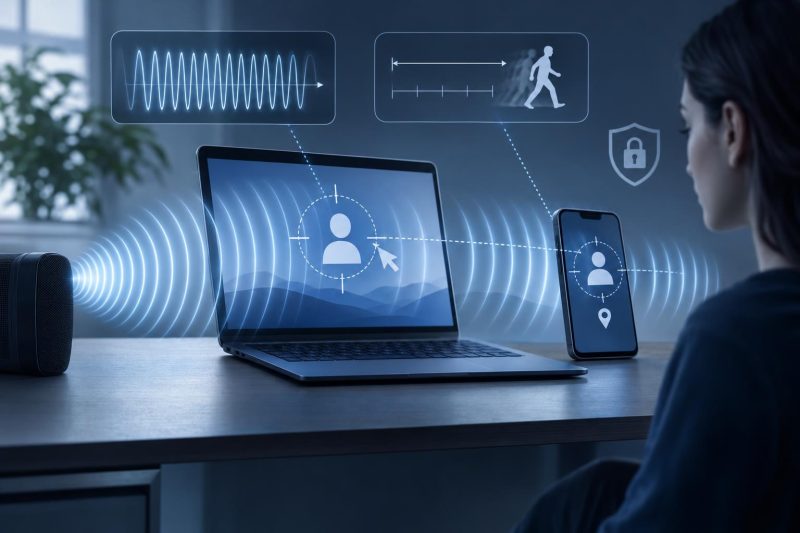
Ultrasonic Tracking (uXDT): inaudible tracking that links your screens and weakens privacy
Ultrasonic Cross-Device Tracking uses inaudible audio beacons to associate televisions, smartphones and connected devices. A discreet technology with significant consequences for security, consent and advertising profiling.
uXDT: when sound becomes a tracking identifier
Ultrasonic Tracking, often referred to by the acronym uXDT for ultrasonic cross-device tracking, describes a family of techniques that make it possible to link the activity of the same user across several devices through ultrasonic signals. These signals, generally emitted at frequencies above 18 kHz, are theoretically imperceptible to most adults, but can be picked up by the microphones of smartphones, tablets, computers or connected assistants.
The principle is simple: a television advertisement, web page, kiosk or application broadcasts an encoded audio beacon. An application with permission to access the microphone detects this beacon, decodes it and sends an event to a server. The operator can then associate the observed broadcast with a device, and then with an advertising profile or household.
A discreet mechanism designed to break down silos between devices
The main commercial benefit of uXDT is the ability to match digital environments that do not naturally share the same identifiers: television and mobile, web browsing and applications, physical displays and smartphones. A brand can thus attempt to measure whether a person exposed to advertising on one screen subsequently performs a search, installs an application or makes a purchase on another device.
Unlike traditional cookies, this approach does not depend solely on the browser. It can therefore bypass, at least in part, certain limitations of conventional web tracking: cookie deletion, browser isolation, private browsing or the fragmentation of identifiers across devices. This is not technical magic: the system still depends on the presence of a compatible application, microphone access, signal quality and collection infrastructure. But its difficult-to-perceive nature is precisely its main risk.
Effects on security and privacy
The first issue is consent. A user may grant microphone access to record a voice message, take part in a call or recognize a song, without imagining that this permission could also be used to detect acoustic beacons and feed a cross-device tracking chain.
The second issue concerns profile building. Associating events originating from a television, a phone and a physical location can reveal habits: times of presence, interests, media consumption, visits to shops or the likely composition of a household. Even when data are presented as pseudonymized, combining them increases the risk of re-identification.
Finally, uXDT expands the attack surface of audio sensors. Researchers have shown that the ultrasonic ecosystem could be used for tracking, but also to trigger unwanted behaviors or establish communication channels that are difficult to detect. In a corporate context, a microphone enabled without an operational need thus becomes a sensor that must be governed in the same way as geolocation, Bluetooth or advertising identifiers.
A technology already under regulatory scrutiny
The issue gained visibility following academic work on ultrasonic beacons and warnings from U.S. authorities concerning Silverpush, a company that offered television-to-mobile matching capabilities. In 2016, the Federal Trade Commission (FTC) notably asked the company to clarify its practices for collecting, sharing and securing data.
In Europe, the use of such mechanisms must be examined in light of the GDPR and rules relating to the storage of, or access to, information on a device. Depending on the context, valid consent must be freely given, specific, informed and unambiguous. Generic microphone permission is not necessarily sufficient to make cross-device advertising tracking use transparent.
Reducing exposure: practical measures
- Revoke microphone access for applications that have no obvious functional need for it.
- Audit advertising and analytics SDKs integrated into mobile applications.
- Monitor network requests and abnormal behavior related to background audio.
- Provide explicit and separate information before any use of ultrasonic detection.
- For organizations, govern microphone use through mobile device management and security policies.
uXDT illustrates a major evolution in tracking: the identifier is no longer only a cookie or an advertising number, but can be carried by the sound environment. The technology still depends on numerous technical conditions, but its opacity requires heightened vigilance from both security teams and those responsible for compliance and data protection.