Triptych: Towards standardizing partial page replacement in the browser
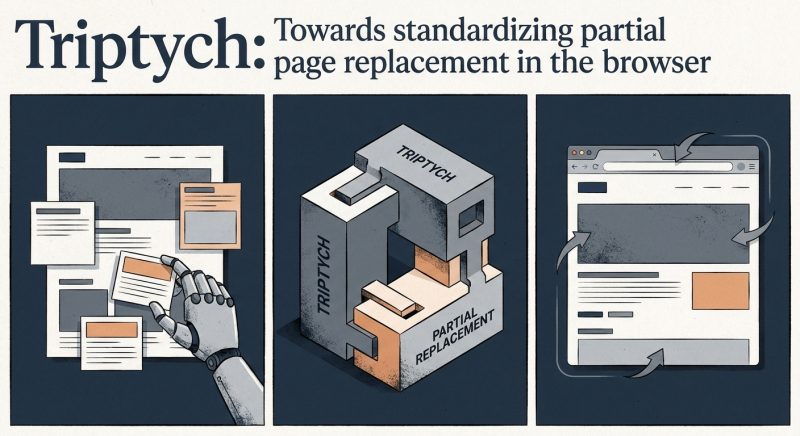
The Triptych project explores the native integration of partial page replacement into the HTML standard, an evolution that could simplify modern Web architecture.
The missing link in native HTML
Since the early days of the Web, HTML has relied on a simple model: navigating from one page to another or submitting a form to reload the entire document. While this model has proven its worth, it is now often seen as insufficient for modern dynamic interfaces. Currently, to update a specific section of a page without a full refresh, developers almost systematically rely on heavy JavaScript libraries to intercept requests and manipulate the DOM.
This is where the Triptych Project comes in. The core idea is to fill a historical gap: giving the browser the native ability to replace a portion of a page with a response from the server, without requiring a complex JavaScript layer. By integrating this functionality directly into HTML specifications, we allow the browser to handle what is currently delegated to third-party frameworks.
The legacy of HTMX: validation through usage
It is impossible to discuss Triptych without mentioning the impact of HTMX. For several years, HTMX has demonstrated that a modern hypermedia model—where the server returns fragmented HTML rather than raw data (JSON)—is not only viable but often more performant and maintainable for a vast category of applications.
HTMX has proven that the hypermedia approach better respects the original architecture of the Web. Triptych does not seek to replace these tools, but proposes to integrate their very essence into the heart of the standard. If a portion of these "Partial Page Replacement" capabilities becomes native, the entire Web ecosystem will benefit. This means fewer dependencies, lighter code, and above all, a return to the roots of progressive enhancement: a page that works natively, whose capabilities are simply enriched by the standard.
Why is this a crucial step?
The importance of this initiative goes beyond simple technical convenience. By reducing reliance on JavaScript for basic interface tasks, we mechanically improve the resilience, accessibility, and performance of sites. The approach advocated by Triptych is part of a desire to simplify the current technology stack, which has often become unnecessarily complex.
As a developer, this direction resonates particularly with my work. With SimpleSL and the development of a Laravel CMS intentionally centered on native HTML, I have chosen to return to an architecture where the server is the master builder. Seeing these ideas, which we apply daily to gain lightness, now being considered as future Web standards is not only encouraging, but confirms that we are following the healthiest trajectory for the Web of tomorrow.
Conclusion
The Triptych project invites us to rethink how we design interactions. It is not about rejecting JavaScript, but about restoring HTML to its central place as a complete interface language. By standardizing partial page replacement, the Web could once again become what it was always meant to be: a robust platform capable of evolving without systematic bloat.
This approach also reflects the philosophy behind SimpleSL, a web development convention focused on semantic HTML, progressive enhancement, and simplicity. Our goal is to prioritize Web standards over dependencies whenever possible, helping developers build websites that are more readable, more durable, and easier to maintain.