The Quiet Data Transfer Revolution: Ultra-Fast QR Codes for 'Wireless' Video
An ingenious developer has transformed QR codes into a surprisingly fast video transmission channel, paving the way for novel data transfers between devices.
QR Codes Reimagined: An Innovation Defying Conventions
Video
In the ever-evolving digital world, where speed and efficiency are essential to optimize workflows, a fascinating discovery has emerged—this time through the lens of "vibe coding"—promising to redefine our approach to data transfer. A passionate developer, known by the pseudonym "Alstroph" on the Reddit platform (r/vibecoding), has developed a method to transmit video using QR codes, all orchestrated by an ingenious mobile application hosted in the repository linked at the bottom of the page...
This is not the first time QR codes have been associated with information transmission. These pixelated squares have become ubiquitous in our daily lives, serving to quickly access websites, share contacts, or make payments. However, their capacity to carry data is generally limited, and the decoding speed, while fast for simple text information, was never designed for complex multimedia streams like video.
The "vibecoding" innovation pushes these limits in a spectacular way. By developing an application capable of generating and displaying thousands of QR codes on the fly, and then "reading" them via a smartphone camera, he has managed to achieve data transfer rates of approximately 150 kilobits per second (Kb/s). While this figure may seem modest compared to the speeds of our current internet connections, it represents a significant advancement in the field of "air-gapped" transfers, meaning those without any physical connection or wireless network.
The Magic of High-Frequency Generation and Reading
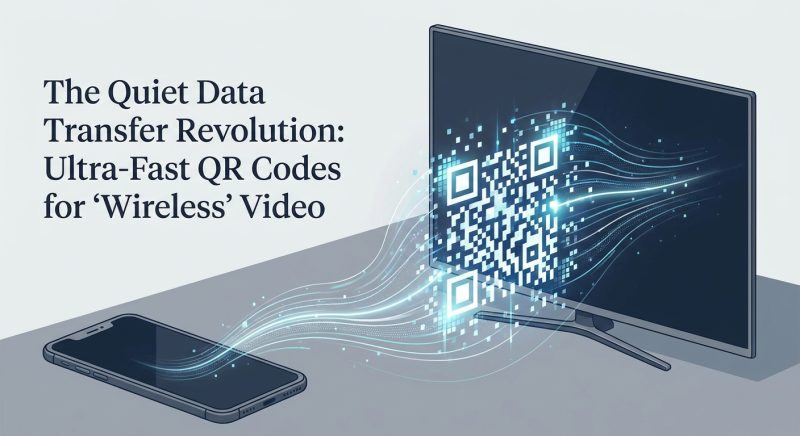
At the heart of this technological feat lies a simple yet powerful idea: exploiting the speed at which a screen can display images and the speed at which a camera can capture and decode them. The application developed by Alstroph displays an extremely rapid succession of QR codes on a screen. Each QR code contains a small portion of the video data. The receiving phone's camera films this screen continuously, capturing the burst of codes.
The true tour de force lies in the application's decoding algorithm. It is capable of processing a continuous stream of QR code images with remarkable efficiency, reconstructing the original video from these digital fragments. This technique bypasses the traditional limitations of QR codes, which are generally designed to be scanned individually and in a more static manner.
In the post published on the r/vibecoding subreddit, the developer explains his approach: "I had an idea for an air-gapped file transfer, capable of transferring files from a screen to a phone using QR codes. I managed to create an application that displays thousands of QR codes on the fly, and by filming them with my phone and my application, I was able to 'download' a video at about 150Kb/s." He also shares impressive visual demonstrations of his application in action, showing the fluidity of the transfer.
I did some research and found another individual who had already conceived this idea, having developed it independently, I presume.
An "Air-Gapped" Transfer: Security and Potential
The term "air-gapped" holds particular importance in this context. It refers to an information system that is physically isolated from any other system, particularly unsecured networks like the Internet. Air-gapped data transfers are often used in environments where security is critical, such as military installations, government infrastructure, or sensitive financial systems. The idea is to prevent any unauthorized intrusion or data leakage.
Alstroph's method offers a new approach to performing air-gapped transfers in a practical and fast way. Imagine having to transfer a large file between two computers in a highly secure environment where no network connection is allowed. Traditionally, this might involve using USB drives, which can themselves present security risks. With this technology, a simple screen and a smartphone would suffice, thereby reducing the potential attack surface.
The developer has also made his work accessible by publishing it on GitHub under the name "airgapped-qr-code-transfer". This allows other developers and tech enthusiasts to examine the code, test it, and potentially contribute to its improvement. This transparency is a pillar of the open-source community and fosters innovation.
Concrete Applications and a Promising Future
Although the speed of 150 Kb/s does not allow for real-time high-definition video streaming, it is already sufficient for a variety of interesting applications. For example, transferring small video files, photos, documents, or critical data between isolated devices becomes much more feasible. One can think of scenarios in areas without internet connectivity, at conferences where rapid information sharing is necessary, or even for technological demonstrations.
One of the most fascinating aspects of this technology is its apparent simplicity. It leverages elements we already use: screens and smartphone cameras. The complexity lies in the software that manages the high-frequency generation and decoding of QR codes. The fact that this innovation comes from an independent developer, sharing his work on community platforms, underscores the power of open-source and individual creativity.
It is also interesting to note that this approach could inspire other developments in the field of visual data transfer. Other projects, such as "decimen-optical-transfer" on GitHub, are already exploring similar concepts of data transmission via optical signals, although often with different goals and technologies. The resonance between these various initiatives shows a growing interest in alternative and potentially more secure data transfer methods.
Challenges and Future Perspectives
Despite its potential, this technology faces certain challenges. The transfer speed, while improved, remains a limiting factor for large video content. The quality of the screen used to display the QR codes and the quality of the receiving phone's camera play a crucial role in the reliability of the transfer. Light interference or rapid camera movements can potentially disrupt decoding.
However, the developer's ingenuity suggests that these challenges could be overcome with future software and hardware optimizations. Increasing the density of QR codes, using more efficient error-correction algorithms, or even exploring new visual representations to encode data could potentially increase the speed and robustness of this system.
Furthermore, Alstroph's idea could serve as a foundation for more advanced applications. One can imagine systems where public screens broadcast information that can be instantly retrieved by passersby via their smartphones, without needing to connect to a Wi-Fi network or use mobile data. This could transform how we interact with our digital environment.
A Look Toward the Future
This development is a fascinating reminder that the technologies we take for granted may still hold unsuspected potential. The QR code, that humble black-and-white square, could well become a major player in secure and fast data transmission, paving the way for new forms of digital interaction. Innovation, whether it comes from large research laboratories or passionate developers sharing their work online, continues to shape our world in surprising ways. This advancement invites us to stay attentive to the next steps of this promising technology.