The Impact of Artificial Intelligence on the Collective Imagination: What Future for Humanity?
From science fiction to work, education, creativity and democracy, artificial intelligence is already transforming how societies imagine their future.
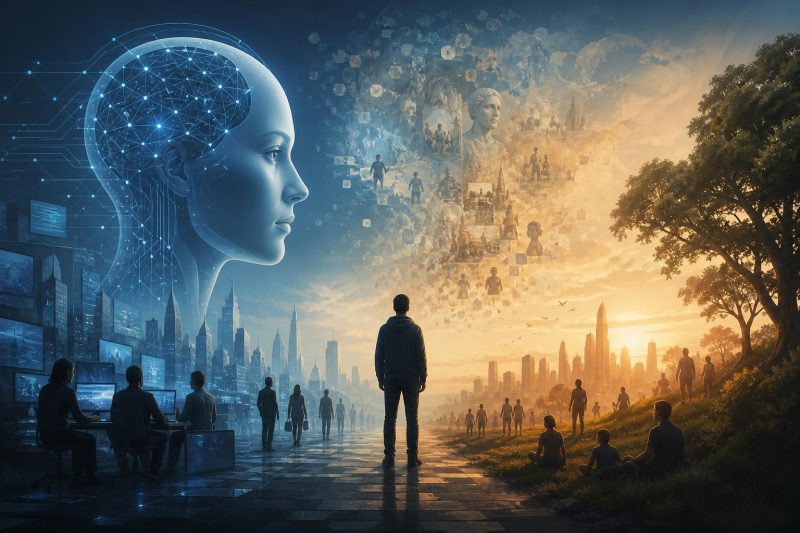
Artificial intelligence is no longer confined to laboratories, science-fiction films or tools reserved for technology companies. With conversational assistants, image generators, translation software and recommendation systems, it has become a familiar part of everyday life. This growing presence is gradually reshaping the collective imagination: in other words, the way a society envisions progress, work, creativity, power and even what makes human beings unique.
For some, AI heralds an era of abundance, in which repetitive tasks will be automated and medicine, education and research will advance more quickly. For others, it fuels fears about job losses, surveillance, information manipulation and growing dependence on a handful of major companies. Between the promise of empowerment and the prospect of dispossession, AI has become one of the defining contemporary narratives about humanity's future.
From Science Fiction to Everyday Life
For a long time, artificial intelligence was associated with humanoid robots, rebellious machines or computers capable of surpassing humans. Works such as 2001: A Space Odyssey, Terminator, Her and Black Mirror have played a major role in embedding these images in popular culture. They continue to influence current debates, sometimes by oversimplifying the real issues.
Yet the AI spreading today is often less spectacular: it sorts job applications, helps draft a text, detects medical anomalies, recommends a video or generates an image from a sentence. This normalisation is changing how the phenomenon is perceived. AI is no longer merely a fiction about the future; it is becoming a discreet infrastructure of the present.
This familiarity nevertheless creates a common misunderstanding. Generative AI systems can produce smooth, convincing responses without actually understanding the world as a human being does. They predict sequences of words, images or sounds from vast datasets. Their apparent intelligence therefore raises a central question in the collective imagination: should a machine that converses, creates or advises be viewed as a tool, a partner or a form of autonomous intelligence?
Work: Between Liberation and Concern
The first issue shaping the imagination of the future is employment. Automation raises hopes of reducing arduous, repetitive or dangerous tasks. In many sectors, AI can assist professionals: document analysis for lawyers, diagnostic support for healthcare workers, fraud detection for banks, programming support for developers and personalised learning pathways for teachers.
But this shift also raises legitimate concerns. The World Economic Forum estimates that technological transformation will both create and eliminate jobs in the coming years. The question, then, is not simply whether AI will “replace” humans, but which occupations will be transformed, how quickly, and for whose benefit.
Two opposing visions emerge in the collective imagination. The first envisions a society in which productivity gains make it possible to work less and devote more time to relationships, creativity or civic engagement. The second fears a polarised labour market, with employees subject to automated monitoring tools and benefits concentrated in the hands of those who control data and computing power.
Human Creativity Redefined
The rise of tools capable of producing text, images, music or video affects an area long presented as distinctly human: creation. For artists, writers, illustrators and musicians, AI is both a working tool and a source of economic vulnerability.
It can speed up idea generation, facilitate initial drafts and make visual creation more accessible. But it also raises questions about the origins of the works used to train models, creators' compensation and the value assigned to content generated in a matter of seconds.
The debate goes beyond intellectual property alone. If a machine can imitate a style, compose a song or write a story, society is invited to redefine what it expects from a work. Originality may not lie solely in the final result, but in the intention, lived experience, perspective on the world and responsibility of the author.
Truth, Information and Democracy
AI is also changing our relationship with truth. The proliferation of synthetic images, voices and videos makes it harder to identify authentic content. Deepfakes can be used for satire or audiovisual creation, but also for fraud, harassment and political disinformation.
In this context, the collective imagination swings between fascination and distrust. Citizens may be tempted to doubt everything, including genuine documents. This poses a significant risk to democratic debate: when visual evidence loses its force, trust in the media, institutions and testimony can erode.
The responses are not purely technical. They involve media literacy, transparency about AI-generated content, platform accountability and the existence of clear rules. The European Union has adopted the AI Act, a framework designed to regulate AI uses according to their level of risk, notably to protect fundamental rights.
What Narrative for Humanity's Future?
AI acts as a mirror: it reveals the expectations, fears and inequalities already present in societies. The real challenge is not to choose between a technological utopia and an inevitable catastrophe. It is to collectively decide which uses are desirable.
A positive future will not depend solely on the performance of algorithms. It will rest on political and social choices: protecting personal data, distributing productivity gains, supporting training, preserving cultural diversity, ensuring transparency in automated decisions and maintaining human capacity for oversight.
Artificial intelligence could expand human capabilities in essential fields, from medical research to the fight against climate change. But it can also reinforce bias, power imbalances and surveillance if deployed without safeguards. The collective imagination therefore has a practical role: it enables us to debate the world we want to build before technological choices become irreversible.