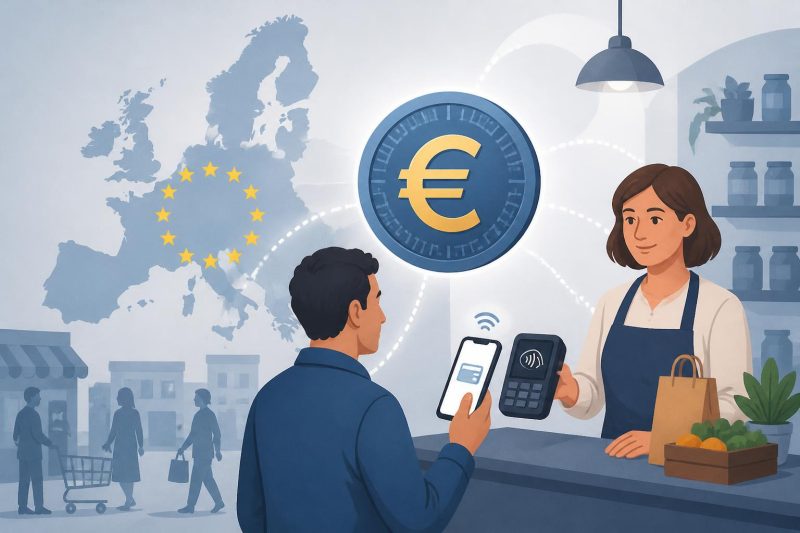
Europe needs merchants for its digital euro
Overview and explanation of the current status of the digital euro, focusing on the importance of merchant engagement and the steps planned through 2029.
What is the digital euro?
The digital euro is a digital form of the central currency of the euro area, issued by the European Central Bank (ECB). Designed as a complement to cash (banknotes and coins), it aims to provide a secure, accessible and reliable digital payment method for citizens and businesses, without replacing physical money. The objective is to ensure that, in an increasingly digital payment world, public money remains available and relevant.
Why merchants are essential
For the digital euro to be useful and widely adopted, it must be accepted where payments happen: at merchants, online and on mobile. Merchants play several key roles:
- Provide acceptance points where consumers can use the digital euro;
- Build trust by offering simple and fast payment experiences;
- Contribute to the development of use cases (in‑store payments, instant refunds, micropayments...) and to payment interface innovation;
- Help collect user feedback to improve the offering and services around the digital euro.
Timeline and steps through 2029
The ECB has structured the project in several phases. After an investigation phase (2021–2023) analysing needs, risks and technical options, the ECB launched in October 2023 an experimentation phase (or “pilot project”) of 24 months to test technical, operational and commercial aspects. This work involves banks, payment service providers, merchants and national authorities.
Key milestones to remember through 2029:
- 2023–2025: Intensive experimentation phase — validation of technical solutions, distribution models (via banks and providers) and merchant acceptance scenarios. Prototypes of acceptance interfaces (terminals, apps, e‑commerce integrations) are tested.
- 2025: Evaluation and policy decision — the ECB will assess the results of the experiment and present a final roadmap with recommendations on actual issuance to the ECB Governing Council.
- 2026–2028: Preparation for possible rollout — if the decision is positive, progressive deployment of infrastructures, preparation of economic actors (merchants, banks, online merchants), and establishment of regulatory and technical frameworks.
- 2029: Public availability horizon — the ECB has indicated that if the political decision is favourable and required conditions are met, the digital euro could be made available to the public around 2029.
Acceptance challenges for merchants
Integrating the digital euro into merchants' daily operations requires overcoming several challenges:
- Adaptation costs: updating payment terminals, integrating with point‑of‑sale systems, training staff.
- Interoperability: ensuring the digital euro works with existing payment solutions (cards, wallets, e‑commerce) and across different providers.
- Economic incentives: defining acceptable cost models (transaction fees, absence of fees to preserve attractiveness versus private means).
- Privacy and compliance: reassuring merchants and consumers about data protection and regulatory compliance (anti‑money laundering, security).
How to encourage merchant adoption?
Several levers are proposed or being tested to promote acceptance:
- Targeted pilot tests with retail chains and SMEs to refine the acceptance experience and reduce integration costs.
- Standardised technical tools (APIs, SDKs, interoperability rules) to simplify implementation in terminals and e‑commerce platforms.
- Support measures and temporary financial incentives to help small merchants equip themselves.
- Information campaigns and educational resources to demonstrate the benefits (speed, security, possible offline payments depending on options, reduced dependence on private providers).
What it means for consumers and businesses
For consumers, the digital euro promises a public payment method, accessible even without a full bank account depending on chosen options, and potentially usable offline. For businesses, it offers a stable and neutral competitive alternative to private wallets, with opportunities for innovation in services (instant payments, automated refunds, new micro‑services).
Conclusion
The digital euro can only succeed if the payment ecosystem adopts it: at the heart of that ecosystem are merchants. Their role is crucial to validate usefulness, test real use cases and provide public accessibility. Steps through 2029 aim to reduce technical and operational risks, define suitable acceptance modalities and encourage uptake through standardised tools and support measures. Success will therefore depend as much on political and technical decisions by the ECB as on the commitment and concrete preparation of European merchants.