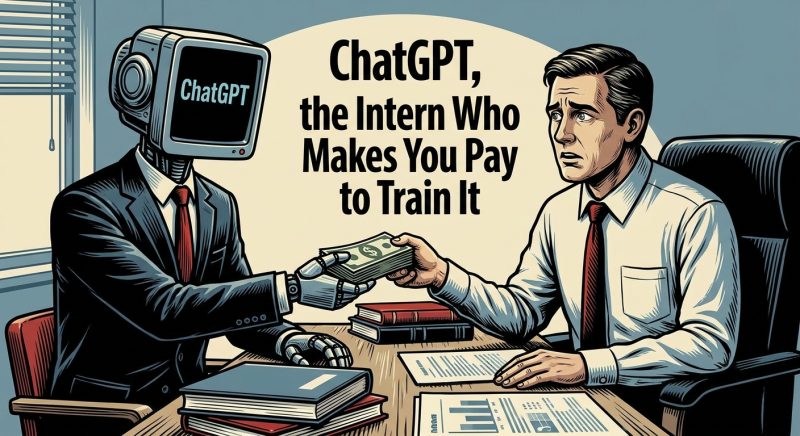
ChatGPT, the Intern Who Makes You Pay to Train It
When the user becomes the free engine of a paid artificial intelligence: a breakdown of a savory technological paradox.
The Paradox of the Century: You Pay to Work
There was a time when learning a trade meant either paying for school or being paid by an employer. In 2024, the world has shifted into a more creative dimension: you pay a monthly subscription (often $20) for the immense privilege of freely training tomorrow's algorithms. Welcome to the era of indirect training, where the user is simultaneously the customer, the trainer, and the guinea pig.
The Vicious Cycle of "RLHF"
Behind this barbaric acronym, Reinforcement Learning from Human Feedback, lies a rather comical reality. Every time you correct an absurd response from your favorite LLM, click the thumbs-up, or rephrase a query to get a decent result, you are polishing the machine's neural circuits.
You're not just using a tool; you're performing unpaid quality control. Imagine walking into a restaurant, paying 20 bucks for your meal, and then spending an hour in the kitchen teaching the chef how to cook a steak without burning it. That's exactly what we do daily with our AI assistants.
Why Do We Accept This Voluntary Servitude?
The answer is in two words: immediate efficiency. We are so fascinated by the machine's ability to draft emails or code scripts that we forget the underlying business model. By correcting the AI, we help it become more performant for the next user. It's a form of forced digital solidarity: you work for free so the software gets better for everyone, including your future competitors.
The Three Pillars of Your Technological "Volunteering":
- Error Correction: Each "Regenerate" is a signal sent to developers indicating the model has failed.
- Data Curation: By validating a relevant response, you confirm that the weight of this information should be increased in future training.
- Labeling: Your complex prompts serve as training data for future versions of the model, which will then be able to answer these questions without your help.
Towards an Awakening?
Should we be indignant about this? Not necessarily. After all, we use these tools to save precious time. But it's healthy to keep in mind that an AI's value lies not only in its software architecture but also in the colossal mass of data and human feedback it ingests. The day the AI is perfect, it won't need us anymore. Until then, enjoy your role as a volunteer teacher: it's undoubtedly one of the rare times in history when the worker pays to have the right to be exploited.
The next time you correct a factual error from your AI assistant, remember that you're not "chatting" with a machine. You're doing its homework for it, while also paying for its lunch.