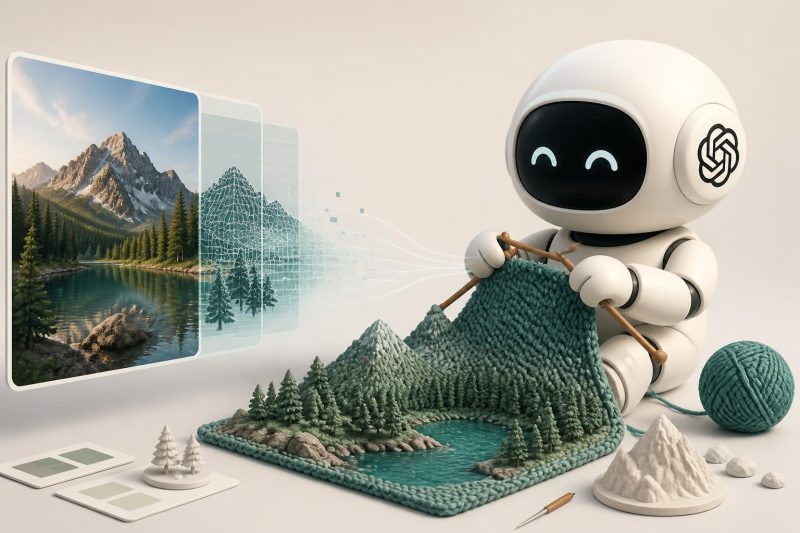
ChatGPT 5.6 Terra: What Multimodal Vision Capabilities Could Bring to 3D Creation
No documented official launch confirms the existence of “ChatGPT 5.6 Terra.” However, progress in vision-language models and multimodal testing is already opening up practical opportunities to accelerate 3D production.
A name to distinguish from official announcements
The name “ChatGPT 5.6 Terra” is not associated, in publicly available official OpenAI product sources, with a technical announcement, product sheet, or published benchmark results. It should therefore not be presented as an officially confirmed version of ChatGPT.
However, the idea that a conversational assistant with multimodal vision capabilities could transform 3D professions is credible and can already be observed through vision-language models. These systems can simultaneously analyze text, images, diagrams, screenshots, documents and, depending on the connected tools, structured data. For studios, 3D artists, architects, and game developers, this evolution promises a more natural interface between creative intent and production software.
Multimodal vision: understanding an image, then acting within a workflow
Multimodality is not just about recognizing the objects in an image. Its value for 3D creation lies in its ability to connect a visual reference with a request expressed in natural language: identifying a mood, describing a composition, spotting perspective inconsistencies, suggesting materials, or proposing a list of modeling actions.
In a production environment, a multimodal assistant could, for example, examine vehicle concept art and then generate a modeling brief: primary volumes, symmetrical parts, moving components, expected levels of detail, and recommended materials. It could also compare a 3D render with a reference image and flag discrepancies: lighting that is too harsh, inaccurate proportions, excessive roughness, missing edge details, or poorly calibrated depth of field.
Practical applications for 3D teams
- Turn a reference board into a structured production brief.
- Analyze a Blender, Maya, Unreal Engine, or Unity screenshot to explain an interface or setting error.
- Create lists of PBR materials from a photograph or concept art.
- Assist with scriptwriting to automate renaming, exports, scene preparation, or quality checks.
- Generate prompt suggestions for image, texture, or 3D reconstruction tools.
- Facilitate exchanges among art direction, developers, integrators, and clients through visual annotations.
MMMUC: caution is needed regarding terminology and claimed results
The acronym “MMMUC” does not, on its own, correspond to a clearly identified reference multimodal benchmark in the sector’s most frequently cited publications. It may refer to an internal designation, a test variant, or confusion with MMMU, short for “Massive Multi-discipline Multimodal Understanding.”
MMMU is a benchmark designed to assess multimodal understanding through questions requiring university-level knowledge across numerous disciplines. Its tasks generally combine text with visual elements such as charts, diagrams, tables, or illustrations. This type of test is useful for measuring visual reasoning, but it does not directly guarantee a model’s quality in a 3D pipeline.
To seriously promote a solution for 3D creation, it is better to avoid relying on isolated general scores. A strong model should be evaluated on practical cases: reading wireframes, recognizing UV errors, ensuring texture library consistency, understanding an architectural plan, following instructions in a 3D interface, analyzing renders, and generating reliable scripts.
What tests would be useful for the future of 3D development?
A relevant testing protocol could combine several assessment categories. The first would focus on visual analysis: the model must accurately describe a scene, recognize objects, understand spatial relationships, and identify visible anomalies. The second would measure its ability to interpret interfaces: property panels, material nodes, object hierarchies, error messages, or render settings.
The third category concerns execution. The assistant should produce accurate instructions, pseudocode, or usable scripts, then be evaluated on the resulting output. In 3D, an answer that appears convincing is not enough: a script must avoid breaking the scene, comply with naming conventions, preserve units, and generate files compatible with the production pipeline.
Finally, evaluation must include the artistic dimension. Can the model preserve the style of an art direction? Can it explain why a render looks artificial? Does it know how to distinguish an objectively technical recommendation from a subjective creative choice? These criteria are essential if AI is to remain a creative copilot rather than a tool that standardizes productions.
An acceleration lever, not a replacement for expertise
Multimodal assistants can reduce the time spent on repetitive tasks, documentation, debugging, and asset preparation. They can also help beginners understand complex software more quickly. For experienced teams, their value lies above all in faster iteration: analyzing a reference, formulating an action plan, suggesting automation, and speeding up validation.
3D creation nevertheless remains dependent on human skills: art direction, optimization, topology, animation, lighting, real-time constraints, intellectual property, and final validation. The future of 3D development will not depend on a model capable of “making an image,” but on tools that can understand a visual context, support a technical decision, and integrate cleanly into existing pipelines.