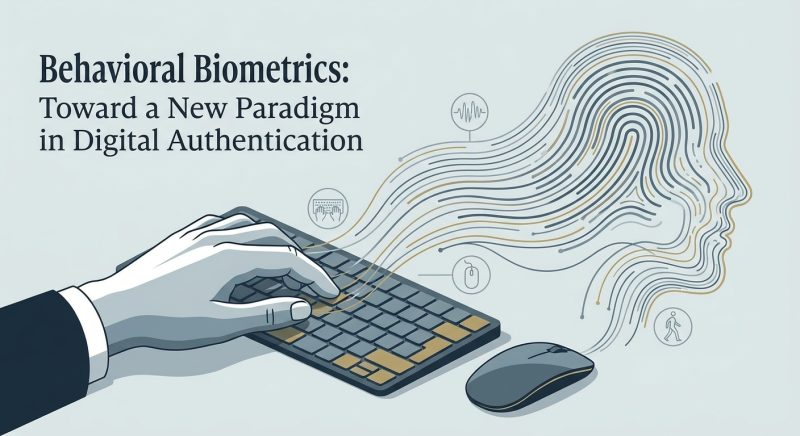
Behavioral Biometrics: Toward a New Paradigm in Digital Authentication
An analysis of behavioral biometrics as a vector for securing digital identities, exploring its mechanisms, technological advantages, and compliance challenges in an evolving cyber ecosystem.
Introduction
In a context of accelerated digital transformation, traditional authentication methods—relying on knowledge factors (passwords) or possession factors (physical tokens)—are revealing critical vulnerabilities in the face of increasingly sophisticated cyber threats. Identity theft and phishing remain predominant attack vectors. Faced with these challenges, behavioral biometrics is emerging as a disruptive solution, shifting the security paradigm: authentication no longer relies on what the user knows or possesses, but on how they interact with their digital environment.
Foundations and Mechanisms of Behavioral Biometrics
Unlike physiological biometrics (fingerprints, facial recognition), which are based on static physical traits, behavioral biometrics analyzes dynamic interaction patterns. This discipline leverages machine learning algorithms to model an individual's unique behavioral profile.
Analyzed parameters include:
- Keystroke dynamics: analysis of speed, pressure, and time intervals between keystrokes.
- Navigation gestures: mouse trajectories, scrolling speed, and pressure exerted on touchscreens.
- Orientation and movement: tilt of the mobile device and handling habits.
- Navigation patterns: site browsing habits and typical user data flows.
The major advantage lies in the "passive" nature of this authentication. Unlike active methods that require explicit user action, behavioral biometrics operates in the background, allowing for continuous session monitoring without compromising the user experience (UX).
Strategic Advantages: Adaptive Security and Fraud Prevention
Integrating behavioral biometrics into cybersecurity architectures offers multi-layered protection. By establishing a baseline of legitimate behavior, systems can instantly detect any anomaly. If a session shows significant deviations from the established profile, the system can trigger remediation measures: Multi-Factor Authentication (MFA) requests, account locking, or access rights limitation.
This approach is particularly robust against Account Takeover (ATO) attacks. Even if a hacker manages to steal valid credentials, it is extremely difficult to mimic the micro-behaviors of the actual victim, rendering the stolen access ineffective.
Integration into Compliance Standards
The adoption of these technologies aligns with rigorous compliance requirements. Companies operating in regulated sectors must meet strict data protection and access control standards. Frameworks such as SOC 2 (Service Organization Control 2) mandate rigorous security and privacy management. Behavioral biometrics, by providing granular traceability and continuous proof of identity, becomes a major asset in demonstrating the effectiveness of internal controls.
Furthermore, alignment with FIDO Alliance (Fast Identity Online) standards is crucial. The current trend is toward interoperability of authentication methods to facilitate the shift to "passwordless" systems. Behavioral biometrics ideally complements FIDO standards by adding a layer of contextual verification that validates session integrity over time.
Ethical Challenges and Technical Limitations
Despite its potential, the deployment of behavioral biometrics raises privacy concerns. The collection and analysis of behavioral data require exemplary data governance, in compliance with the GDPR. The challenge lies in anonymizing behavioral vectors while ensuring sufficient precision to avoid false positives (rejecting a legitimate user) and false negatives (accepting an intruder).
Technically, behavioral variability—linked to stress, fatigue, or equipment changes—requires continuous learning capabilities in AI models to maintain a high level of performance without compromising usability.
Conclusion
Behavioral biometrics is more than just a technological innovation; it represents a fundamental paradigm shift in digital identity management. By transforming the user into a permanent authentication factor, it offers increased resilience against sophisticated threats. As AI models become more precise, the integration of this technology will undoubtedly become a cornerstone of "Zero Trust" security strategies for tomorrow's academic and corporate organizations.