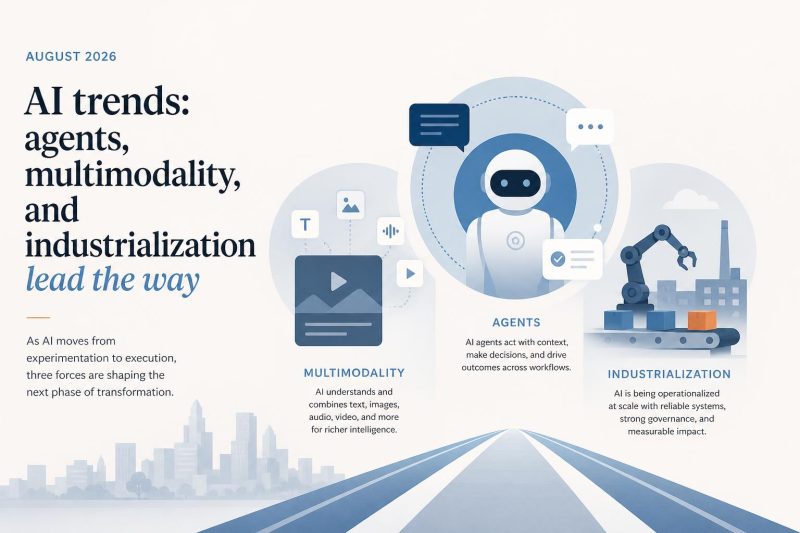
August 2026 AI trends: agents, multimodality, and industrialization lead the way
In August 2026, AI is accelerating toward more autonomous, multimodal, and better-governed systems. Overview of the key trends: agents, pragmatic “reasoning,” on-device AI, security and compliance, and inference cost optimization.
A more “agentic” AI: from assistance to execution
The throughline of the AI news in August 2026 is the rise of agents capable of completing end-to-end tasks: planning, using tools (search, APIs, databases), verifying, and executing. Where conversational assistants often limited themselves to answering, these systems now target operational objectives (for example: processing a case file, preparing a regulatory summary, launching a business workflow).
The trend is not only “more autonomy”: it also comes with a stronger need for control (safeguards, human validation, logging) to limit errors and drift. In enterprises, this evolution translates into more finely segmented agent architectures, with verification steps and escalation mechanisms.
Multimodality becomes the norm: text, image, audio, and video
In August 2026, multimodality is establishing itself as a standard: models no longer just understand text, but also interpret images, audio, and increasingly video streams or time series (e.g., industrial imaging, inspection, and content analysis).
This shift responds to concrete use cases: assisted diagnosis, quality control, technical support guided by screenshots, analysis of scanned documents, and more natural interaction (via voice). Product teams are working to reduce friction: less re-keying, more “context input” through visual or audio inputs.
“Pragmatic” reasoning: aiming for reliability over complexity
Another notable trend concerns how to improve the quality of responses. Rather than increasing model size alone, the focus is shifting toward robust reasoning techniques: better planning, step-by-step verification, use of external sources (retrieval), and reducing hallucinations through constraints and controls.
In production environments, the criterion is no longer performance “on benchmarks” alone, but stability: consistency, traceability, the ability to refuse when information is missing, and adaptation to the business context.
RAG and “knowledge pipelines”: industrializing access to data
RAG (Retrieval-Augmented Generation) approaches remain central, but they are evolving toward more industrialized knowledge pipelines: ingestion, cleaning, indexing, freshness control, access-rights management, and continuous evaluation.
In practice, teams are looking to strengthen “grounding”: better targeting of documents, improving search relevance, and coupling answers with citations or verifiable elements. This structuring is particularly important in regulated sectors.
On-device AI and inference cost optimization
August 2026 also sees progress in on-device AI (or inference on more optimized infrastructure). The reasons are twofold: reduce latency and control costs, while improving confidentiality (less exposed data).
At the same time, inference cost optimization is becoming a major initiative: quantization, distillation, model orchestration (smaller models for most queries, larger models for difficult cases), and performance improvements per token.
Security, compliance, and governance: “by design”
AI governance is intensifying: security policies, tests against malicious uses (prompt injection, exfiltration), permission management, and decision traceability. Organizations are multiplying safeguards: output filtering, output validation, logging, and human review procedures.
In the EU and beyond, compliance remains a key driver: transparency requirements, data management, and attention to systemic risks. Companies are increasingly integrating compliance directly into the architecture (access controls, usage limits, documentation of models and pipelines).
Personalization and “workflows”: AI as a process building block
Finally, personalization is moving from “tailor-made chat” to workflows: integration with existing tools (CRM, ERP, ticketing, documentation), automation of repetitive tasks, and contextualized assistance.
The expected result: measurable gains (time saved, fewer errors, improved service) and better internal adoption thanks to interfaces aligned with business practices.
Key takeaways
- Agents: shift toward task execution, with control and validation.
- Multimodality: text-image-audio understanding (and more).
- Reliability: pragmatic reasoning, verification, and grounding.
- Industrialized RAG: knowledge pipelines, freshness, and access rights.
- Costs and latency: on-device AI and inference optimization.
- Security & compliance: governance built in from the start.